

Why You Keep Repeating the Same Patterns (It's Not What You Think)
You've read the books. You've done the journaling. You've had the realizations, the ones where you could see exactly what was happening, name it clearly, even explain it to someone else. And still, somehow, you end up in the same argument, the same shutdown, the same spiral of overthinking at 2am.
If that sounds familiar, you're probably not missing awareness. You're missing something underneath it.
There's a layer that doesn't get addressed when you learn a coping skill or a breathing technique: the place where your nervous system made a decision, years ago, about how to keep you safe, and has been running that program faithfully ever since. Whether you've been in therapy for years or you're just starting to connect the dots, what follows is about that layer.

The Real Reason Patterns Are So Hard to Break
Most of us approach our patterns the way we'd approach a bad habit. We see it, we name it, we try to change it. And for a while, it might even work, until we're tired, triggered, or under real pressure. Then the pattern is right back, as strong as it ever was.
That's because most patterns aren't habits in the conventional sense. They're survival strategies. They formed in response to something: an environment that felt unpredictable, relationships where your needs weren't consistently met, experiences where the only safe option was to go quiet, go hard, or disappear entirely.
When your nervous system learned that a certain way of responding kept you safer, it stored that response at a level far deeper than conscious thought. Which is why knowing better doesn't automatically lead to doing better. You can intellectually understand your pattern and still feel completely hijacked by it the moment you're under stress.
That's not a failure of willpower or insight. It's physiology.
Understanding Survival Patterns, And Why Yours Is Not a Flaw
"Survival patterns" is useful language because it points to what these behaviors actually were: not random, not character flaws. Adaptations. Your nervous system got creative with what it had, and it did the best it could with what was available.
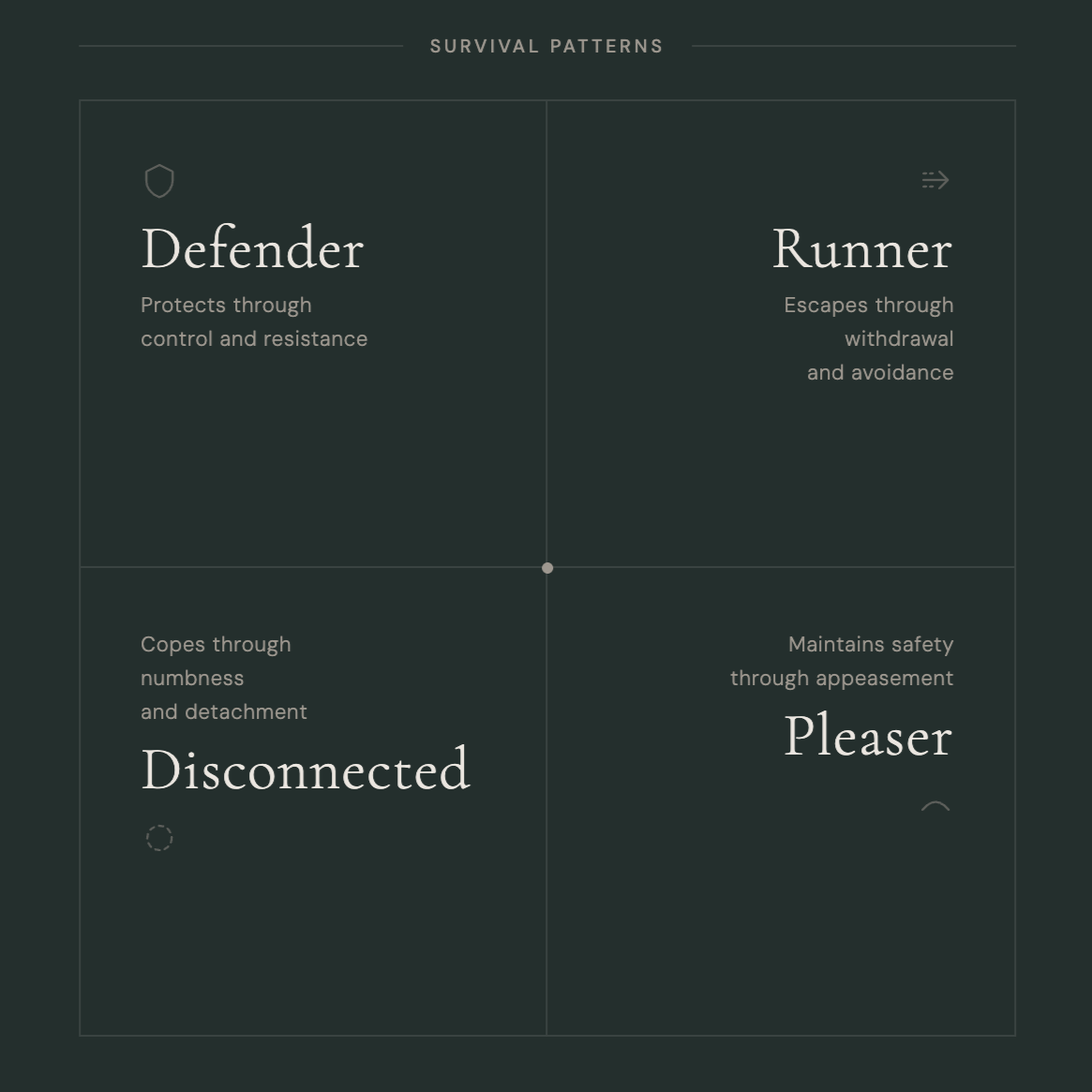
There are four core survival patterns that most people cycle through under stress, and most of us have a dominant one:
→ The Defender
Goes on the offensive when threatened. Argues, controls, pushes back. May look like anger on the outside; underneath, it's usually fear doing the talking.
→ The Runner
Withdraws, avoids, or escapes when things feel like too much. Can show up as busyness, deflection, changing the subject, or literally leaving. This isn't laziness; it's protection.
→ The Disconnected
Goes flat or numb. Checks out, zones out, loses access to emotion or decision-making under pressure. The nervous system said: too much, shut it down.
→ The Pleaser
Fawns, accommodates, shrinks. Keeps others calm by managing their experience, often at significant cost to their own. People-pleasing as a trauma response is one of the most misunderstood patterns. It looks like kindness, but it's rooted in survival.
None of these are personality flaws. They're your nervous system's best attempt at safety, given what it learned.
Why Awareness Alone Is Not Enough
One of the most common things I hear from people who've done significant personal development work is: "I know exactly what I'm doing. I just can't stop doing it."
Awareness is supposed to be the first step, and it is. But awareness of a pattern and regulation of the nervous system running it are two different things. You can see the fire alarm going off and still feel your heart pounding. Knowing the building isn't on fire doesn't stop the alarm; your body is already responding. Your nervous system has to learn, through experience rather than understanding alone, that it's safe to respond differently.
That's the layer most tools skip. The Root Cause Roadmap was built for people who are self-aware, doing the work, and still feeling stuck. It helps you understand not just that you have a pattern, but where it came from and why it made sense, so you can meet it with something other than frustration or shame.
What It Actually Looks Like to Shift a Pattern
Shifting a pattern isn't about eliminating the response. It's about creating more space between the trigger and your reaction, and that space is where choice starts to live.
It usually starts with curiosity rather than judgment. Instead of "why do I keep doing this," the question becomes "what was this protecting me from?" That reframe shifts you out of self-blame and into understanding, which is where actual change becomes possible.
From there, it's about learning to work with your nervous system rather than against it. Grounding strategies help, but they work best when you understand which pattern you're in and what it's communicating. A Defender needs something different than someone who goes Disconnected. A Pleaser's path toward regulation looks different than a Runner's.
Knowing your survival pattern isn't a label to carry. It's practical information.
If you're ready to start building that map, the Root Cause Roadmap is a self-paced workshop you can complete in under 60 minutes. It includes a companion workbook and a survival patterns assessment, a structured starting point for people who are ready to understand themselves at a deeper level.
And if you're wondering whether what you're experiencing might benefit from one-on-one support, you're welcome to explore my assessment options here(available in South Carolina only).
Frequently Asked Questions
Why do I keep repeating the same patterns even when I know better?
Awareness is a starting point, not a finish line. Patterns persist because they live at the level of the nervous system, not just in conscious thought. Knowing your pattern intellectually doesn't automatically regulate the body's survival response. The shift tends to happen when you understand where the pattern came from and begin working with your nervous system directly, rather than trying to override it with willpower or insight alone.
Is people-pleasing a trauma response?
For many people, yes. People-pleasing, sometimes called the fawn response, often develops in environments where keeping others calm or happy felt necessary for safety. It can look like generosity or agreeableness on the surface, but it's rooted in an underlying sense that your own needs come second to managing someone else's reaction. Recognizing this can be a meaningful first step in shifting the pattern without shame.
What are the four survival patterns?
The four core survival patterns are Defender (goes on offense under threat), Runner (withdraws or avoids), Disconnected (goes numb or flat), and Pleaser (accommodates and appeases to maintain safety). Most people have a dominant pattern, though you may cycle through different ones depending on the situation or the relationship. These patterns form in response to early experiences, not as character flaws.
Can you understand your patterns without a therapist?
You can absolutely begin to understand your patterns on your own, and self-awareness is a meaningful part of the process. Tools like the Root Cause Roadmap are designed to help you do exactly that in a structured way. Some people find that self-paced work opens up real clarity. Others find it surfaces things they want to explore further in a therapeutic relationship. Both are valid paths.
How long does it take to shift a trauma pattern?
There's no universal timeline. It depends on how long the pattern has been in place, what kind of support is available, and how consistently you're able to practice different responses. What tends to help most is understanding the pattern's origin first, then working with the nervous system over time rather than trying to force a change. Shift is possible; it usually looks more like gradual expansion than a single breakthrough moment.
You Do Not Have to Keep Running the Same Program
If you've made it here, you probably recognized yourself somewhere in this post. That recognition matters. It's often where something different begins.
The patterns you carry made sense at some point. They kept you safe when you didn't have other options. You have more options now, and understanding where your patterns come from is one of the more compassionate things you can do for yourself.
If you want a structured starting point, the Root Cause Roadmap is a short, self-paced workshop that helps you identify your survival pattern, understand its origins, and meet yourself with a little more clarity and a little less blame.
And if you're in the Aiken, SC area and feel ready for something more personalized, I'd invite you to learn more about working together.
Disclaimer: This blog is for general educational purposes only. It is not therapy, and reading it does not create a therapist-client relationship between you and Sydney Carter, LPC, or Shadow Work Psychotherapy. It is not a substitute for working with a licensed mental health professional and should not be used to diagnose or treat any condition.
READ MORE LIKE THIS:

What does a comprehensive diagnostic evaluation cost, and what's actually included? A clear breakdown for Aiken, SC adults deciding if it's worth it.